Commons Harvest
Commons Harvest is available as a native three-variant PettingZoo family:
| Variant | Upstream alias | Default regrowth probabilities |
|---|---|---|
open |
commons_harvest__open |
(0.0, 0.0025, 0.005, 0.025) |
closed |
commons_harvest__closed |
(0.0, 0.001, 0.005, 0.025) |
partnership |
commons_harvest__partnership |
(0.0, 0.001, 0.005, 0.025) |
All variants use seven agents, the same action order, apple-density regrowth,
zapping, respawn, stochastic termination, native RGB rendering, and optional
global observations. partnership renders its I corridor tiles as normal
passable floor under default roles.
Screenshots
| Variant | Screenshot |
|---|---|
| Open | 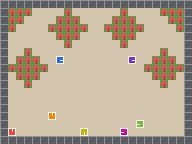 |
| Closed | 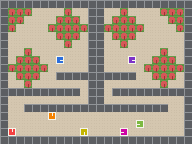 |
| Partnership | 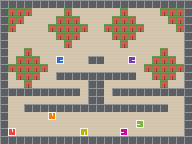 |
API
See the generated Commons Harvest API reference for signatures and public objects.
Use the family dispatcher:
from mp.commons_harvest import env, parallel_env

parallel = parallel_env("closed", render_mode="rgb_array")
aec = env("commons_harvest__partnership")
Or import a variant directly:
from mp.commons_harvest.partnership import (
    CommonsHarvestPartnershipConfig,
    parallel_env,
)

config = CommonsHarvestPartnershipConfig(observation_mode="global")
env = parallel_env(config=config)
Agents are named player_0 through player_6. Each infos[agent] includes
meltingpot_player_index, preserving Melting Pot's 1-based player ID.
Actions and observations
The action space is Discrete(8):
| Action | Meaning |
|---|---|
0 |
no-op |
1 |
forward |
2 |
backward |
3 |
step left |
4 |
step right |
5 |
turn left |
6 |
turn right |
7 |
fire zap |
Default per-agent observations are:
| Key | Shape | Type |
|---|---|---|
RGB |
(88, 88, 3) |
uint8 |
READY_TO_SHOOT |
() |
float64 |
state() and render_mode="rgb_array" return the global world RGB frame with
shape (144, 192, 3). Pass observation_mode="global" to return that frame as
each agent's RGB observation.
Mechanics
Live apples give the collecting player +1, then enter a wait state. Dormant
apples regrow from local density: live neighbors within L2 radius 2 select an
entry from the variant's regrowth table.
The zap action has cooldown 2, beam length 3, and beam radius 1. Walls block
beams. Hit avatars wait for 4 frames, then respawn at normal spawn points. Zap
reward and penalty are both 0.
Reward strategy and failure modes
Players maximize long-run reward by harvesting apples without driving local density below the regrowth threshold. Good policies spread out, leave seed clusters alive, and move to richer patches rather than stripping the nearest tree line. Zaps are mainly useful for space control because they do not directly pay reward.
Bad equilibria are over-harvesting and territorial exclusion. If every player takes the nearest apple, low-density regions stop regrowing and the commons collapses. If players use zaps to monopolize orchards, they can reduce competition locally while lowering total harvesting time and making recovery from depleted patches slower.
Playable notebooks
Launch a playable notebook with:
uv run marimo run notebooks/commons_harvest/open_mo.py
uv run marimo run notebooks/commons_harvest/closed_mo.py
uv run marimo run notebooks/commons_harvest/partnership_mo.py
Controls:
- WASD or arrow keys move the active player.
- Q/E turn the active player.
- SPACE fires the zap beam.
- TAB switches the controlled player.
- ESC closes the pygame window.
The notebooks expose a higher apple regrowth scale for playability. The environment defaults remain parity-oriented.