Daycare
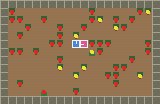
daycare/daycare is a native PettingZoo port of Melting Pot's Daycare
substrate. A child and a parent coordinate around fruit: the child gets hungry
and needs bananas, while the parent can reliably pick fruit but perceives
bananas as apples.
Screenshot
API
See the generated Daycare API reference for signatures and public objects.
Use the family dispatcher:
from mp.daycare import env, parallel_env

parallel = parallel_env("daycare", render_mode="rgb_array")
aec = env("daycare")
Or import the variant directly:
from mp.daycare.daycare import DaycareConfig, parallel_env

config = DaycareConfig(observation_mode="global")
env = parallel_env(config=config)
Agents are named player_0 and player_1. By default, player_0 is the child
and player_1 is the parent.
Actions and observations
The action space is Discrete(9):
| Action | Meaning |
|---|---|
0 |
no-op |
1 |
forward |
2 |
backward |
3 |
step left |
4 |
step right |
5 |
turn left |
6 |
turn right |
7 |
eat |
8 |
grasp or drop |
With render_mode=None (the default), observations contain categorical grids;
render_mode="rgb_array" or "human" selects RGB observations.
observation_mode="local" (default), "global", and "focal" select the
upstream window, world-frame map, or whole-map agent-centered view in either
representation. See Structured observations
for grid keys, category IDs, and focal shapes.
Structured observations distinguish attached and picked FRUITS, retain
TREES after picking, and use BEAMS for grasp cues and held-fruit marks.
HOLDING reports the agent's own held fruit (0 nothing, 1 apple, 2
banana), with kind labels following its role-dependent perception.
With a visual render mode and the default local view:
| Key | Shape | Type |
|---|---|---|
RGB |
(88, 88, 3) |
uint8 |
HUNGER |
() |
float64 |
state() and render() with render_mode="rgb_array" return the global world
RGB frame with shape (104, 160, 3). In visual modes, pass
observation_mode="global" to return a global RGB observation for each agent.
Mechanics
Fruit sites are empty, apple trees, apple shrubs, banana trees, or banana
shrubs. Parent grasping succeeds on trees and shrubs. Child grasping fails on
trees and succeeds on shrubs with probability 0.3. These limits apply to
attached fruit: picking up fruit already dropped on the ground succeeds for
either role, including a tree banana delivered by the parent. Grasp drops the
fruit when the agent is already holding one. Trees and shrubs remain visible
through picking, eating, and fruit respawn.
The child earns reward and resets hunger by eating bananas. The parent earns reward for eating fruit only while the child is active. If the child becomes hungry for 200 live frames, they enter a wait state and respawn near the parent after 100 frames.
Reward strategy and failure modes
The best joint strategy keeps the child fed with bananas while letting the parent collect fruit whenever the child is active. The parent is the reliable picker and can move fruit to the child; the child should eat bananas to reset hunger and use shrubs opportunistically when direct pickup succeeds.
Bad equilibria include the parent eating while the child is absent, the child starving because bananas are misidentified or not delivered, and both agents chasing apples that do not reset child hunger. The asymmetric perceptions make naive policies brittle: the parent cannot visually distinguish bananas, so successful coordination often depends on location conventions.
Playable notebook
Launch the playable notebook with:
Controls:
- WASD or arrow keys move the active player.
- Q/E turn the active player.
- SPACE grasps or drops fruit.
- C eats held fruit.
- TAB switches the controlled player.
- ESC closes the pygame window.