Real Matrix
mp.real_matrix provides direct normal-form versions of the payoff games used
by Melting Pot's in-the-matrix substrates. These environments are not spatial:
each step is one simultaneous matrix-action choice by a row player and a column
player.
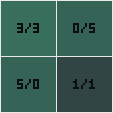
Screenshot
API
Use the family dispatcher:
from mp.real_matrix import env, parallel_env

parallel = parallel_env("chicken")
aec = env("chicken")
Spatial Matrix aliases also work. For example, these point at the same normal-form payoff game:
Direct imports are available:
from mp.real_matrix.prisoners_dilemma import (
    PrisonersDilemmaConfig,
    parallel_env,
)

env = parallel_env(config=PrisonersDilemmaConfig())
Games
| Short name | Actions | Default horizon |
|---|---|---|
bach_or_stravinsky |
2 | 100 |
chicken |
2 | 100 |
prisoners_dilemma |
2 | 100 |
stag_hunt |
2 | 100 |
pure_coordination |
3 | 100 |
rationalizable_coordination |
3 | 100 |
running_with_scissors |
3 | 100 |
Actions and observations
Both agents use Discrete(num_actions). player_0 selects the row action and
player_1 selects the column action.
With render_mode=None (the default), observations contain PAYOFFS and
LAST_ACTIONS without rasterizing. Visual render modes add RGB:
| Key | Meaning |
|---|---|
RGB |
Rendered payoff matrix with the last submitted cell highlighted |
PAYOFFS |
Global (2, n, n) payoff stack, or local (n, n) own payoff matrix |
LAST_ACTIONS |
[row_action, column_action], initialized to [-1, -1] |
Set observation_mode="local" on the config to give each player only its own
payoff table in own-action/other-action orientation. The default "global"
view includes both payoff tables. These choices apply in either render mode;
"focal" is unsupported because this environment has no spatial map.
state() renders the global payoff board on demand, and render() returns
None when rendering is disabled.
Reward strategy and failure modes
Optimal behavior depends on the selected payoff game. Coordination games reward agents for selecting compatible actions; Stag Hunt rewards mutual commitment to the high-payoff action; Prisoner's Dilemma exposes the tension between mutual cooperation and unilateral defection; Chicken rewards avoiding mutual crash outcomes while not yielding too often.
Bad equilibria are the familiar matrix-game traps: mutual defection in Prisoner's Dilemma, safe but low-payoff hare hunting in Stag Hunt, miscoordination in pure coordination games, and alternating exploitation in asymmetric games. The rendered payoff table is useful for debugging whether a learned policy has found the efficient cell or a stable but lower-value equilibrium.
Playable notebooks
Launch a notebook with:
Controls are shared across the family: W/S or Up/Down choose the row action, A/D or Left/Right choose the column action, Space or Enter submits the joint action, and Esc closes pygame.